




What Are the Main Applications of a Rotary Vacuum Evaporator in Modern Laboratories?

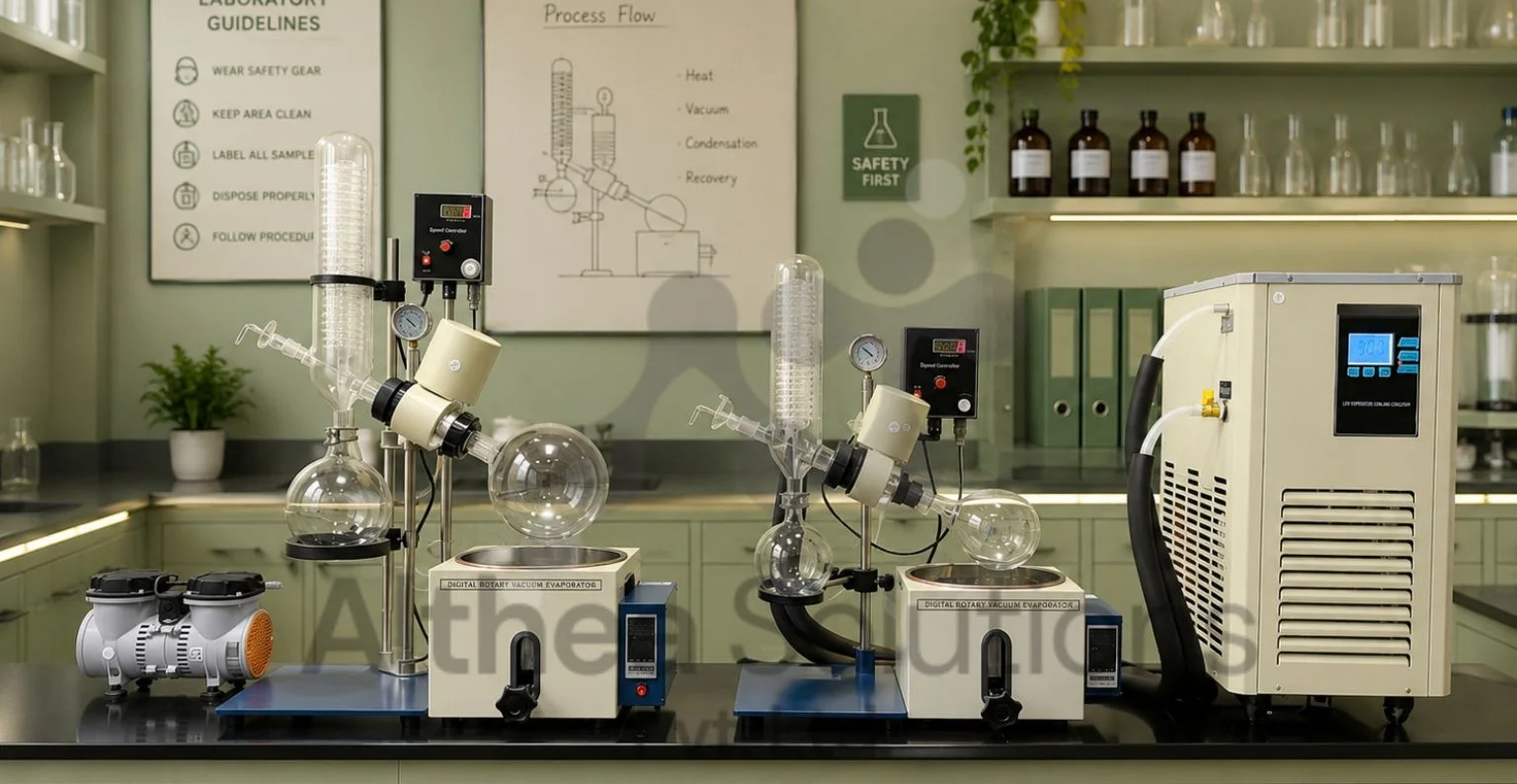
A rotary vacuum evaporator is widely used in modern laboratories for solvent removal, sample concentration, purification, extraction, and solvent recycling. By combining rotation, controlled heating, and vacuum evaporation, this laboratory instrument enables efficient processing of samples while supporting accurate laboratory workflows. It is a core piece of laboratory equipment used across pharmaceutical, chemical, biotechnology, and research environments.
What Is a Rotary Vacuum Evaporator?
A rotary vacuum evaporator, often called a 'rotary evaporator', is a laboratory evaporator designed to remove solvents from liquid samples under reduced pressure.
The system rotates a flask containing the sample while heat is applied. A vacuum pump lowers the boiling point of the solvent, allowing volatile solvent evaporation at lower temperatures. The evaporated solvent passes through a condenser system, where it condenses and can be collected for reuse.
This method is widely used because reduced pressure evaporation improves efficiency, supports temperature-sensitive materials, and enhances laboratory processing.
Main Applications of a Rotary Vacuum Evaporator in Modern Laboratories
Solvent Removal and Concentration of Solutions
One of the most common uses of an evaporation machine is solvent removal and the concentration of solutions. Laboratories often need to remove excess solvent after synthesis, extraction, or analytical procedures.
A rotary evaporation system enables controlled vacuum evaporation, helping scientists concentrate samples while maintaining product quality. This process is widely used in a chemical laboratory, pharmaceutical laboratory, and research laboratory to prepare samples for further analysis or processing.
Sample Purification
Sample purification is another important application. During purification workflows, solvents are removed after extraction or reaction steps.
The laboratory evaporator helps separate desired compounds from residual solvents efficiently. Scientists use this approach during chemical processing, analytical applications, and research applications where purified samples are required before testing, formulation, or characterisation.
Recrystallisation
Recrystallisation is commonly used to improve compound purity. In this process, the solvent volume is carefully reduced to encourage crystal formation.
A rotary vacuum evaporator provides accurate temperature control and evaporation rates, making recrystallisation more consistent. This technique is widely used in pharmaceutical research and chemical synthesis laboratories where high-purity compounds are required for development and evaluation.
Natural Product Extraction
Many laboratories involved in natural product extraction use rotary evaporators to concentrate extracts obtained from plants, herbs, and biological materials.
Following solvent extraction, the solvent can be removed efficiently while preserving valuable compounds. This application is common in biotechnology research, food science, academic studies, and industrial laboratory applications focused on natural ingredients and bioactive substances.
Solvent Recycling
Solvent recovery and solvent recycling support efficient laboratory operations. During evaporation, condensed solvents can be collected and reused where appropriate.
This form of laboratory solvent recovery reduces solvent consumption and supports sustainable laboratory practices. The integrated condenser system captures evaporated solvents, making the process practical for routine laboratory workflow requirements.
Drying of Samples
A rotary evaporator can assist with the drying of samples after purification, extraction, or concentration procedures.
By removing residual solvent under controlled conditions, laboratories can prepare materials for storage, testing, or further processing. This application is common in biotechnology research, pharmaceutical development, and general laboratory scale production activities.
Evaporation of Volatile Solvents in Biochemistry
Biochemistry laboratories frequently work with solvents that evaporate readily. A rotary vacuum evaporator allows efficient handling of these materials through vacuum distillation and controlled evaporation.
The combination of a vacuum pump, recirculating chiller, and condenser system supports effective solvent collection. This makes the equipment valuable for biochemical studies, protein research, and other analytical applications involving sensitive samples.
Industries That Use Rotary Vacuum Evaporators
|
Industry |
Typical Application |
Key Benefit |
|---|---|---|
|
Pharmaceutical |
Sample purification and formulation development |
Efficient solvent removal |
|
Chemical |
Chemical processing and solvent extraction |
Improved laboratory efficiency |
|
Biotechnology |
Biotechnology research and sample preparation |
Gentle sample concentration |
|
Academic Research |
Research applications and analytical studies |
Flexible laboratory workflow |
|
Food & Natural Products |
Natural product extraction and solvent recovery |
Preservation of valuable compounds |
What Features Should Laboratories Consider?
When selecting a rotary vacuum evaporator, laboratories should evaluate several important factors:
- Temperature control for accurate processing conditions
- Condenser design for effective solvent condensation
- Vacuum performance for efficient reduced pressure evaporation
- Capacity selection based on sample volume requirements
- Workflow requirements and integration with existing systems
Althea Solutions offers laboratory evaporation equipment in capacities ranging from 1L to 50L. These systems feature temperatures up to 180°C, temperature accuracy of ±1°C, rotary speeds up to 120 rpm, a vertical condenser configuration, and optional vacuum pump and recirculating chiller accessories. Such features help laboratories align equipment selection with their processing needs.
Key Takeaways
- A rotary vacuum evaporator is primarily used for solvent removal and sample concentration.
- It supports purification, recrystallisation, and extraction workflows.
- Solvent recovery enables practical solvent recycling.
- Vacuum-assisted evaporation improves processing efficiency.
- It is widely used across pharmaceutical, chemical, biotechnology, and academic laboratories.
Frequently Asked Questions
Q1. What is a rotary vacuum evaporator used for?
Answer: A rotary vacuum evaporator is used for solvent removal, sample concentration, sample purification, recrystallisation, natural product extraction, solvent recycling, and drying of samples. It is a widely used laboratory instrument for research, analytical work, and routine laboratory processing.
Q2. How does a rotary vacuum evaporator work?
Answer: The system rotates a sample flask while heat is applied. A vacuum lowers the solvent boiling point, allowing evaporation at lower temperatures. The vapour passes through a condenser system, where it condenses and is collected. This process supports efficient solvent removal and recovery.
Q3. Why is vacuum evaporation preferred in laboratories?
Answer: Vacuum evaporation reduces solvent boiling temperatures through reduced pressure evaporation. This approach supports temperature-sensitive materials, improves laboratory efficiency, and enables faster processing. It is widely used for sample concentration, purification, and solvent recovery applications.
Q4. Can a rotary vacuum evaporator recover solvents?
Answer: Yes. During solvent evaporation, vapours pass through a condenser system and are converted back into liquid form. This allows laboratories to perform solvent recovery and solvent recycling, supporting efficient laboratory operations and resource management.
Q5. Which industries commonly use rotary evaporators?
Answer: Rotary Evaporators are commonly used in pharmaceutical laboratories, chemical laboratories, biotechnology laboratories, academic research facilities, food science laboratories, and natural product research centres. They support a wide range of research equipment and laboratory processing applications.


