


Tissue Homogenizers in Genomics Research: Applications and Benefits

Genomics research depends on precise sample preparation. Whether laboratories are studying DNA, RNA, proteins, or cellular structures, the quality of sample processing directly influences the consistency and reproducibility of analytical workflows.
Tissue Homogenizers play an important role in modern genomics by enabling efficient tissue disruption and creating homogeneous sampling conditions. A well-designed sample homogenizer supports high-throughput workflows and helps research laboratories process a wide variety of biological samples with precision.
What is a Tissue Homogenizer?
A Tissue Homogenizer is a laboratory instrument that mechanically disrupts biological samples to produce a uniform mixture suitable for molecular and cellular analysis.
Tissue homogenisation involves:
- Measurement precision
- Cell lysis and material dispersion
- Sample blending
- Uniform particle distribution
- Preparation for DNA and RNA extraction workflows
By creating homogeneous sampling conditions, researchers can work with representative samples that support accurate genomic studies and reproducible analytical processes.
Why Tissue Homogenizers Are Important in Genomics Research
Genomics studies often involve analysing complex biological samples such as animal tissues, plant materials, bacteria, and microorganisms. Preparing these samples uniformly is essential for obtaining consistent molecular data.
Tissue Homogenizers support genomics research by:
- Creating uniform sample preparation conditions
- Improving laboratory efficiency
- Enabling high-throughput sample processing
- Supporting precision molecular analysis
Homogeneous sampling ensures that each portion of a processed sample contains a similar distribution of cellular material. This consistency supports sequencing workflows, nucleic acid extraction, and downstream molecular applications.
Applications of Tissue Homogenizers in Genomics Research
DNA and RNA Extraction
DNA and RNA extraction procedures require effective tissue disruption and cell lysis. A sample homogenizer produces fine and uniformly processed samples that improve extraction efficiency and support reliable genomic workflows.
Molecular Biology Research
Molecular biology laboratories frequently process tissues, cells, and microorganisms for gene expression studies and genomic investigations. Tissue homogenisation creates consistent starting material for these applications.
Pharmaceutical and Biotechnology Research
Pharmaceutical and biotechnology organisations use Tissue Homogenizers for biological sample preparation, toxicity studies, formulation development, and research programmes involving molecular diagnostics and genomic studies.
Microbiology and Bacterial Studies
Bacterial cultures and microorganisms require efficient cell disruption techniques. Tissue homogenisation enables the preparation of representative samples suitable for molecular investigations and microbiological analysis.
Forensic and Toxicology Applications
Forensic laboratories rely on precise sample preparation methods when processing biological materials. Homogeneous sampling supports efficient extraction procedures and consistent analytical workflows.
Food Science and Agricultural Research
Food science and agricultural laboratories use Tissue Homogenizers to process plant tissues, seeds, roots, stems, and microbial samples for molecular research and genomic investigations.
How Homogeneous Sampling Improves Genomic Studies
Homogeneous sampling is the process of producing a uniform distribution of sample material throughout a processed specimen.
In genomics research, homogeneous sampling contributes to:
- Consistent nucleic acid extraction
- Uniform particle distribution
- Reliable sequencing workflows
- Improved repeatability across experiments
- Efficient molecular analysis
When samples are prepared uniformly, researchers can perform genomic studies with greater consistency and confidence in their analytical workflows.
Features to Consider in a Sample Homogenizer
Research laboratories require sample preparation systems that combine precision, efficiency, and flexibility.
Important considerations include:
High-Throughput Processing
The ability to process multiple samples simultaneously supports efficient genomics workflows and improves laboratory productivity.
Frequency Control
Adjustable homogenisation speed enables researchers to optimise sample preparation conditions for different biological materials.
Multiple Grinding Modes
Modern laboratory workflows often benefit from wet, dry, and low-temperature grinding capabilities.
Programmable Operation
Touchscreen interfaces and programmable settings support consistent sample preparation and reproducible experimental conditions.
Low-Noise Performance
Laboratory-friendly operation contributes to a comfortable working environment while maintaining processing efficiency.
Grinding Media Compatibility
Compatibility with different grinding beads provides flexibility for processing animal tissues, plant materials, bacteria, and microorganisms.
Comparison: Genomics Requirements and the Role of Tissue Homogenizers
|
Requirement in Genomics Research |
Role of Tissue Homogenizers |
|---|---|
|
DNA extraction |
Uniform tissue disruption |
|
RNA extraction |
Consistent sample preparation |
|
Cell lysis |
Efficient homogenisation |
|
High-throughput studies |
Multi-sample processing |
|
Research reproducibility |
Homogeneous sampling |
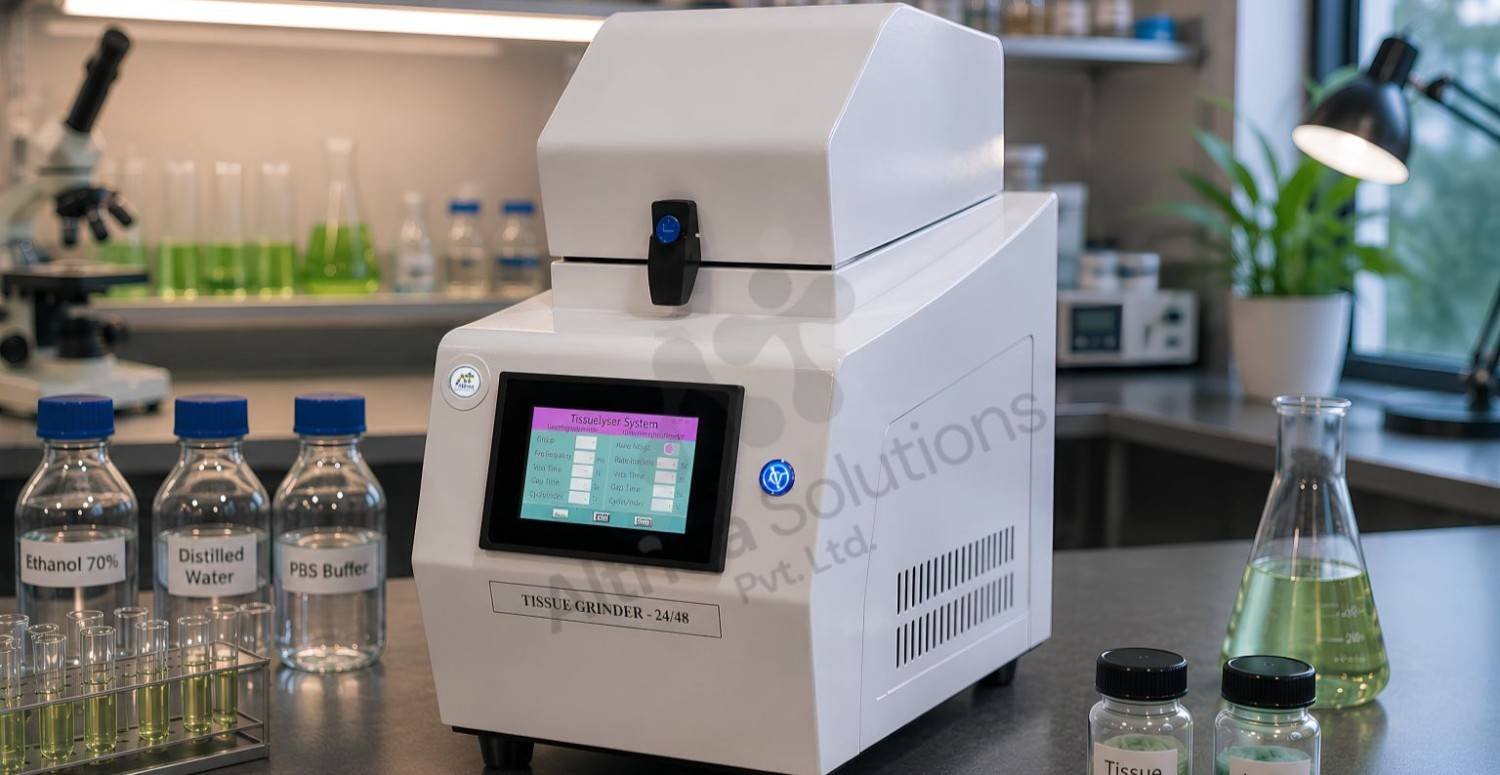
Althea Solutions' Ultimate Sample Homogenizer for Genomics Research
The Ultimate Sample Homogenizer from Althea Solutions is designed for precision tissue homogenisation, grinding, cell disruption, material dispersion, sample blending, and oscillation-based homogenisation.
The system incorporates high-frequency oscillation technology and an advanced three-dimensional motion mechanism that supports efficient sample processing across a broad range of applications.
The homogeniser is suitable for:
- Biological sample preparation
- DNA and RNA extraction workflows
- Molecular biology research
- Pharmaceutical studies
- Forensic investigations
- Food science testing
- Microbiological applications
Its compact laboratory design, programmable operating modes, and flexible sample configurations make it well suited to modern genomics and molecular biology laboratories.
Key Specifications of the Ultimate Sample Homogenizer
|
Specification |
Ultimate Sample Homogenizer |
|---|---|
|
Frequency Range |
0–70 Hz |
|
Sample Capacity |
24 × 2 mL |
|
Time Setting |
0–9999 seconds |
|
Noise Level |
Below 55 dB |
|
Particle Size Output |
Approximately 5 μm |
|
Grinding Modes |
Wet, dry and low-temperature |
|
Compatible Grinding Beads |
Stainless steel, zirconia, tungsten carbide and quartz |
|
Suitable Samples |
Animal tissues, plant tissues, bacteria and microorganisms |
|
Acceleration |
Approximately 2 seconds to maximum speed |
|
Deceleration |
Approximately 2 seconds |
The system also supports multiple sample configurations and interchangeable adapters for different tube volumes, making it suitable for diverse genomics workflows.
The Growing Role of Tissue Homogenizers in Genomics Research
As genomics research continues to expand across molecular biology, pharmaceutical development, biotechnology, forensic science, and food testing, precise sample preparation remains essential for efficient laboratory workflows.
Tissue Homogenizers support tissue disruption, cell lysis, and homogeneous sampling, enabling consistent genomic sample preparation and reliable molecular analysis. A modern sample homogenizer combines high-throughput performance, precision homogenisation, and flexible processing capabilities to support the needs of contemporary research laboratories.
The Ultimate Sample Homogenizer from Althea Solutions brings together high-frequency oscillation technology, programmable operation, and versatile sample processing capabilities, making it well suited for genomics and molecular biology laboratories seeking efficient and reproducible sample preparation solutions
Frequently Asked Questions
Q1. What is a Tissue Homogenizer used for in genomics research?
Answer: A Tissue Homogenizer prepares biological samples through mechanical disruption and blending, creating uniform samples suitable for DNA extraction, RNA extraction, and molecular analysis.
Q2. Why is homogeneous sampling important?
Answer: Homogeneous sampling creates a consistent distribution of sample material, supporting reproducible genomic workflows and efficient molecular analysis.
Q3.Can a sample homogenizer be used for DNA and RNA extraction?
Answer: Yes. A sample homogenizer prepares tissues and cells for nucleic acid extraction by producing uniformly processed samples suitable for molecular studies.
Q4. Which samples can be processed using Tissue Homogenizers?
Answer: Tissue Homogenizers can process animal tissues, plant tissues, bacteria, microorganisms, seeds, roots, stems, and various biological samples used in genomics research.