




Top Applications of Tissue Homogenizers in Biotechnology & Pharmaceutical Research

Modern laboratories depend heavily on accurate sample preparation for reliable research outcomes. Whether researchers are working on DNA extraction, pharmaceutical analysis, microbiology studies, or forensic investigations, the quality of sample processing directly affects the final results.
This is why a tissue homogeniser has become an essential part of biotechnology and pharmaceutical workflows. A reliable sample homogeniser helps laboratories process biological materials quickly, consistently, and with better reproducibility across experiments.
As research projects continue becoming more data-driven and sample-intensive, laboratories are also looking for faster and more efficient molecular biology sample preparation systems that can handle multiple samples without affecting quality or consistency.
Why Tissue Homogenizers Matter in Modern Research
A modern laboratory tissue homogeniser is designed to break down tissues, cells, and biological samples into uniform mixtures suitable for downstream analysis. This process plays an important role in improving reproducibility, which is critical in biotechnology and pharmaceutical research.
Traditional manual grinding methods can often result in inconsistent sample preparation, uneven particle sizes, and contamination risks. Automated sample preparation equipment helps overcome these challenges by delivering controlled and repeatable homogenization.
Some important advantages include:
- Improved consistency across research samples
- Faster sample preparation workflows
- Reduced manual handling and contamination risks
- Better compatibility with analytical and molecular techniques
Reliable laboratory homogenisation systems also help researchers save time while improving overall workflow efficiency.
Key Applications of Tissue Homogenizers
DNA and RNA Extraction
One of the most common uses of a pharmaceutical tissue homogeniser is in DNA and RNA extraction. Molecular biology laboratories require high-quality nucleic acid samples for sequencing, PCR testing, gene expression studies, and other genomic applications.
Efficient tissue disruption is important because incomplete homogenisation can reduce nucleic acid quality and extraction efficiency. Advanced cell disruption equipment ensures biological samples are processed uniformly before extraction begins.
Many laboratories now prefer a high-throughput tissue homogeniser because it can process multiple samples simultaneously while maintaining consistent grinding performance.
Pharmaceutical Research and Drug Development
Pharmaceutical laboratories frequently process tissues, powders, capsules, and biological compounds during formulation development and analytical testing. Consistent homogenization supports better reproducibility in research and quality control workflows.
Researchers involved in drug development often require:
- Uniform sample preparation for analytical accuracy
- High-speed sample processing for larger studies
- Consistent grinding performance across sample batches
Reliable pharmaceutical research tools help laboratories maintain precision while supporting faster and more organised research workflows.
Microbiology and Cell Disruption
Microbiology laboratories use tissue grinding systems for bacterial cell disruption, protein extraction, microbial studies, and enzyme analysis. Proper homogenization allows researchers to isolate intracellular components more effectively.
In biotechnology applications, microbial samples often require controlled mechanical disruption to avoid damaging sensitive biomolecules. Automated systems provide programmable settings that help researchers maintain better control during sample processing.
This makes a sample homogeniser useful for:
- Protein extraction workflows
- Cell lysis applications
- Enzyme activity studies
- Microbial culture analysis
Standardised homogenisation also helps improve consistency between experiments.
Food and Environmental Testing
Food testing laboratories rely on laboratory grinding equipment for contamination analysis, pesticide residue testing, additive evaluation, and microbial testing. Environmental laboratories similarly process soil, plant, and water samples for analytical studies.
A dependable Laboratory Tissue Homogenizer helps laboratories achieve uniform particle distribution before testing begins. Consistent sample preparation improves the accuracy of molecular and chromatographic analysis.
High-throughput processing is especially useful for laboratories managing large sample volumes daily.
Forensic and Clinical Laboratories
Forensic science and clinical diagnostics often require careful preparation of biological evidence and trace samples before analysis. Accurate homogenization helps improve sample consistency while reducing handling variability.
Clinical and forensic laboratories commonly use homogenization during:
|
Application Area |
Purpose of Homogenization |
|---|---|
|
Molecular Biology |
DNA and RNA extraction |
|
Pharmaceutical Research |
Drug formulation analysis |
|
Food Testing |
Residue and contamination testing |
|
Forensic Science |
Biological evidence preparation |
|
Clinical Diagnostics |
Tissue and fluid sample processing |
Reliable sample preparation helps improve the accuracy and repeatability of laboratory findings across these applications.
Features Researchers Look for in a Modern Tissue Homogenizer
Important features commonly considered include:
- Touchscreen programmable controls for workflow flexibility
- Low-noise operation for improved laboratory comfort
- Compatibility with wet, dry, and low-temperature grinding
- Uniform grinding performance across multiple samples
A modern high-throughput tissue homogeniser should also support increasing laboratory workloads while maintaining reproducible processing conditions.
How the Ultimate Sample Homogenizer Supports Advanced Research
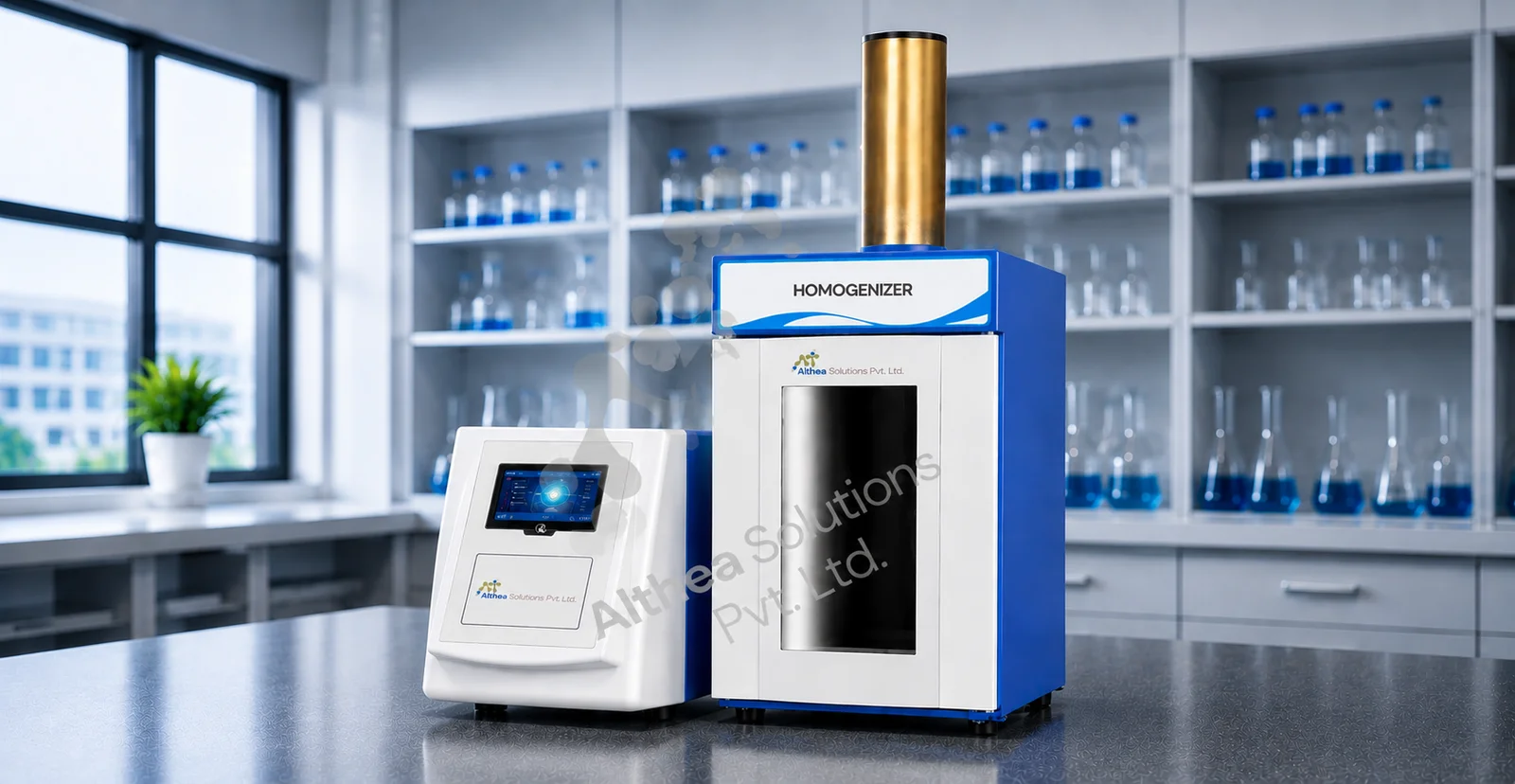
The Ultimate Sample Homogenizer – ALHUSH-24 by Althea Solutions is designed to support demanding laboratory workflows across biotechnology, pharmaceutical, forensic, and food testing applications.
This advanced biotechnology research equipment system supports high-throughput sample processing with the ability to process up to 24 × 2 ml or 48 × 2 ml samples simultaneously. Its three-dimensional motion system helps deliver uniform grinding performance across different biological materials.
Researchers handling DNA and RNA extraction workflows can also benefit from its compatibility with wet, dry, and low-temperature grinding applications.
Key operational features include:
- Frequency range from 0–70 Hz for controlled sample processing
- Low-noise operation below 55 dB
- Touchscreen programmable interface for workflow customization
- Fast acceleration and deceleration for efficient processing
Its consistent high-speed sample processing capability makes it suitable for laboratories handling multiple research applications where reproducibility and efficiency are important.
Advancing Laboratory Research with Better Sample Preparation
Efficient sample preparation remains one of the most important steps in biotechnology and pharmaceutical research. From molecular biology sample preparation to forensic testing and microbiology workflows, consistent homogenization helps laboratories improve reproducibility, efficiency, and analytical accuracy.
As laboratory workloads continue increasing, researchers require dependable sample preparation equipment that can process larger sample volumes while maintaining uniform grinding performance. Features such as programmable controls, low-noise operation, and automated processing help support smoother laboratory workflows.
The Ultimate Sample Homogenizer is designed to meet these evolving laboratory requirements through reliable high-throughput processing and flexible application compatibility.
Researchers and laboratories looking for dependable sample preparation performance can consider the Ultimate Sample Homogenizerfor biotechnology, pharmaceutical, forensic, and food testing workflows.
Frequently Asked Questions
Q1. What is a tissue homogenizer used for?
Answer: A Tissue Homogenizer is used to break down tissues, cells, and biological materials into uniform mixtures for laboratory analysis. It supports applications such as DNA and RNA extraction, protein studies, microbiology research, and pharmaceutical testing.
Q2. Why is homogenization important in pharmaceutical research?
Answer: Homogenisation helps create consistent samples for analytical testing, formulation studies, compound analysis, and quality control processes in pharmaceutical laboratories.
Q3. What are the advantages of a high throughput tissue homogenizer?
Answer: A High Throughput Tissue Homogenizer allows laboratories to process multiple samples simultaneously, helping improve workflow efficiency, reduce manual effort, and maintain reproducible sample preparation.
Q4. Can tissue homogenizers be used for DNA and RNA extraction?
Answer: Yes. Many modern cell disruption equipment systems are specifically designed to support DNA and RNA extraction workflows by providing efficient tissue disruption before nucleic acid isolation.
Q5. Which industries commonly use laboratory tissue homogenizers?
Answer: Laboratory tissue Homogenizers are widely used in biotechnology research, pharmaceutical laboratories, food testing facilities, forensic science laboratories, environmental analysis centres, and clinical diagnostic laboratories.


