



What is an HPLC column washing pump? Complete Guide for Laboratories

In HPLC workflows, performance issues often develop gradually rather than appearing as immediate failures. A column that initially produces stable and reproducible results may begin to show small variations over time. Retention times shift slightly, peak shapes lose definition, and system pressure may no longer remain consistent.
These changes are often linked to what remains inside the column after repeated use.
High-performance liquid chromatography relies on controlled separation. However, residues from samples, buffers, and solvents can accumulate within the column structure. If not removed effectively, they begin to influence future analyses.
An HPLC column washing pump is used to address this specific problem by providing a controlled and repeatable method for cleaning the column.
What is an HPLC column washing pump?
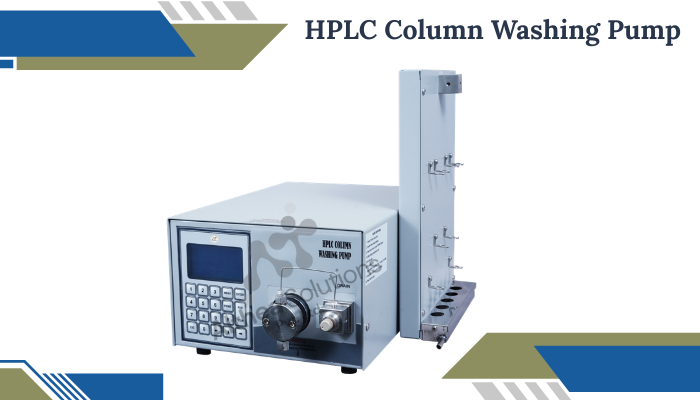
An HPLC column washing pump is a dedicated pump system designed to pass cleaning solvents through a chromatography column under controlled flow conditions to remove accumulated contaminants.
It differs from routine flushing because it isolates the cleaning process and maintains consistent flow and pressure. This improves the effectiveness of HPLC column cleaning and supports stable analytical performance over time.
In practice, it allows column maintenance to be performed as a defined and repeatable step rather than an informal extension of analytical runs.
Why Column Washing Becomes a Limiting Factor
Column washing is part of most laboratory routines, but the method used often determines how effective it actually is.
In many cases, cleaning is performed through the main HPLC pump system. While this approach can remove loosely held residues, it does not always address compounds that are more strongly retained within the stationary phase.
Over time, this leads to accumulation. The effects are not always immediate, which makes the issue harder to identify. Instead of a clear failure, the system shows gradual variation.
This variation introduces uncertainty. Results that were previously consistent may require additional verification. Columns may be replaced more frequently without a clear understanding of why their performance declined.
From a maintenance perspective, incomplete column washing becomes a limiting factor rather than a supporting process.
How an HPLC Column Washing Pump Works
The operation of a column washing pump is based on controlled solvent delivery.
The system draws a selected solvent from a reservoir. The choice of solvent depends on the type of residues present in the column. Organic compounds, buffer salts, and strongly retained analytes require different cleaning approaches.
Once the solvent is selected, the pump delivers it through the column at a stable flow rate. This stability is important. Cleaning efficiency depends not only on the solvent but also on how consistently it moves through the column.
As the solvent passes through, it interacts with retained materials and gradually removes them. The process is continuous and controlled, which improves reproducibility.
At the end of the cycle, the column is returned to a condition that is closer to its initial performance state.
Manual Cleaning Compared with Pump Based Cleaning
Manual cleaning methods are commonly used and can be sufficient in simple scenarios. However, they depend on how the system is operated during cleaning.
When the main HPLC pump system is used for flushing, the process is influenced by analytical settings and operator adjustments. Flow rates may vary, and cleaning duration is not always consistent.
This introduces variability. Some residues may be removed effectively, while others remain within the column.
There is also a risk of applying conditions that are not optimal for the column, either due to time constraints or uncertainty in method selection.
A dedicated chromatography cleaning pump separates cleaning from analysis. It provides a controlled environment where solvent delivery, flow rate, and duration are defined and repeatable.
The difference is not only in efficiency but in consistency across multiple cleaning cycles.
How to Clean HPLC Columns Step by Step Using a Washing Pump
A structured approach helps maintain consistency in column cleaning.
- Begin by disconnecting the column from the analytical system. This ensures that the cleaning process is isolated and fully controlled.
- Select a solvent that matches the type of contamination. Organic residues typically require organic solvents, while buffer salts require aqueous solutions.
- Connect the column to the washing pump and start with a moderate flow rate. Stability is more important than speed during this step.
- Monitor system pressure throughout the process. Stable pressure indicates proper flow, while unexpected changes may suggest blockage or heavy contamination.
- After cleaning, flush the column with a suitable solvent for storage or immediate reuse.
This step by step process supports repeatable HPLC column maintenance without introducing additional variability.
When a Washing Pump Becomes Necessary
The need for a washing pump usually becomes clear when manual cleaning no longer restores column performance reliably.
One indicator is repeated variation in results despite consistent analytical conditions. Another is an increase in maintenance frequency, where columns require more attention but do not maintain performance after cleaning.
Laboratories working with complex samples often encounter this earlier. Strongly retained compounds are more difficult to remove using standard flushing methods.
At this stage, the focus shifts from occasional cleaning to controlled maintenance. A washing pump supports this transition by providing a defined and repeatable process.
Impact of Inadequate Column Washing
If column washing is not performed effectively, the internal condition of the column changes over time.
Retained materials can alter the interaction between the stationary phase and incoming analytes. This affects separation behaviour and introduces variability in results.
Common effects include:
- Reduced resolution in separations
- Gradual shifts in retention time
- Carryover between consecutive runs
- Increased baseline noise
In regulated environments, these variations have broader implications. Guidance from organisations such as the FDA and WHO emphasises reproducibility and data integrity. Inconsistent results can require additional validation or reanalysis.
From an operational perspective, inadequate cleaning also increases downtime. Time spent troubleshooting and repeating analyses can exceed the time saved by simplified cleaning methods.
How to Choose the Right HPLC Column Washing Pump
Selecting a suitable washing pump involves evaluating how it will be used within the laboratory workflow.
The scale of operation is one factor. Laboratories with higher sample throughput benefit from systems that support consistent and repeated cleaning cycles.
Sample type is another consideration. Complex matrices require more effective cleaning, which places greater importance on controlled solvent delivery.
Compatibility with existing systems should also be considered to ensure smooth integration.
Beyond initial cost, long-term reliability is an important factor. A system that improves cleaning consistency can reduce column replacement frequency and minimise interruptions.
Laboratories that prioritise stable workflows often look for solutions that are designed specifically for analytical environments. Providers such as Althea Solutions focus on this area by offering equipment that supports consistent maintenance practices.
How Althea Solutions Supports Modern Laboratories
Consistent HPLC performance depends on how well maintenance processes are implemented. Column cleaning is one part of that process, but its effectiveness depends on the tools used.
Althea Solutions provides laboratory equipment designed to support stable and repeatable workflows. Their approach focuses on practical usability, compatibility, and long term performance.
For laboratories that are moving from occasional maintenance to more structured processes, having a dedicated solution for column washing can improve both efficiency and reliability.
Althea Solutions aligns with this requirement by offering systems that support controlled and consistent HPLC column maintenance.
FAQs
Q1. What does an HPLC column washing pump do?
Answer: It delivers cleaning solvents through an HPLC column under controlled conditions to remove contaminants and maintain performance.
Q2. How often should HPLC columns be cleaned?
Answer: Cleaning frequency depends on usage and sample type, but it is typically performed after a sequence of runs or when performance begins to change.
Q3. Can column washing be done without a pump?
Answer: It can be done manually, but the process is less consistent and may not remove strongly retained residues effectively.
Q4. Which solvents are used for column cleaning?
Answer: Common solvents include methanol, acetonitrile, and water based solutions, selected based on the type of contamination.
Q5. Does column washing improve analytical accuracy?
Answer: Effective cleaning supports consistent retention times, better peak shape, and overall reproducibility.